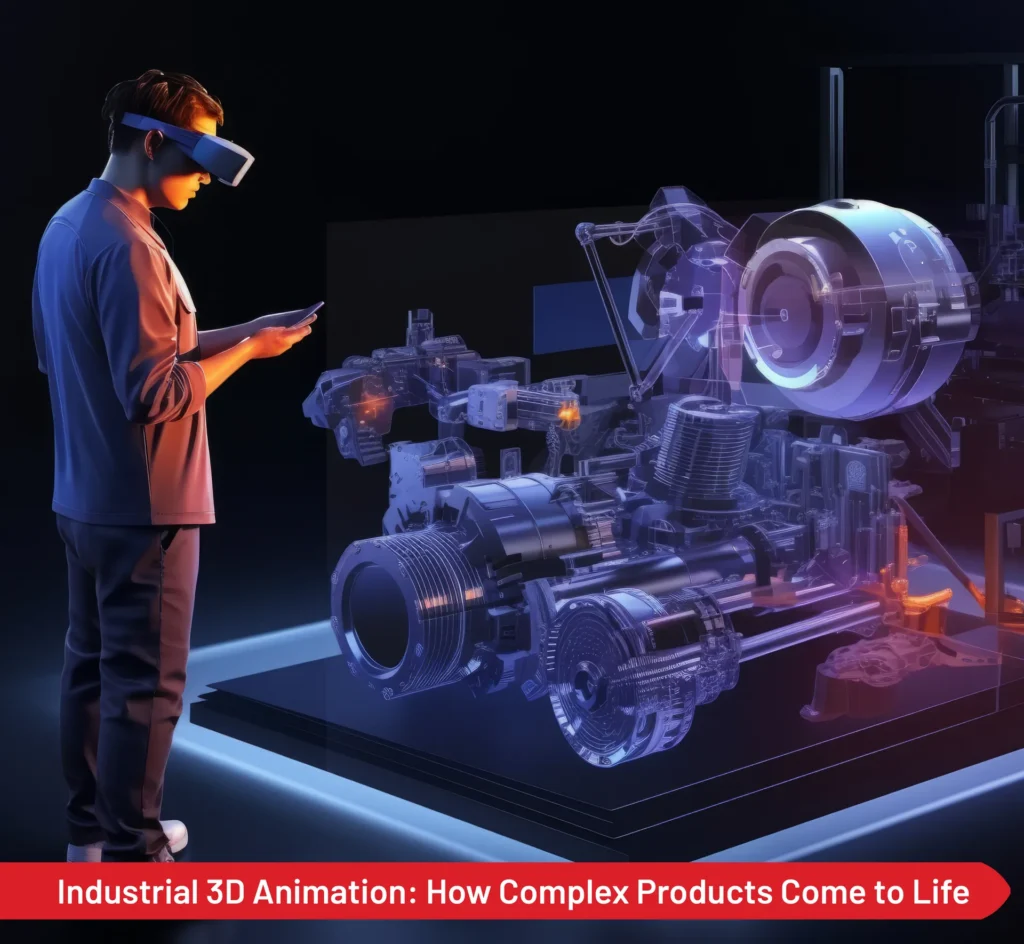
Manufacturing and engineering companies often work with products that are difficult to explain using traditional photography, diagrams or conventional video.
A machine may contain hundreds of components. A medical device may have internal mechanisms that cannot be seen while operating. An industrial process may involve multiple stages happening inside equipment that is impossible to film from the right angle.
This is where industrial 3D animation becomes valuable.
Instead of simply showing what a product looks like, 3D animation can show how it works, how its components interact, what happens inside it and why it matters to the customer.
For manufacturers, engineering companies, technology businesses and industrial brands, this can turn highly technical information into visual communication that sales teams, customers, investors and employees can understand.
In this guide, we’ll explore what industrial 3D animation is, where it is used, how the production process works and when it makes sense for a business.
What Is Industrial 3D Animation?
Industrial 3D animation is the use of computer-generated 3D models, environments, materials, lighting and animation to explain industrial products, machinery, engineering systems or manufacturing processes.
Unlike a simple product render, an industrial animation can demonstrate movement and interaction.
For example, an animation can show:
- How a machine operates
- How individual components work together
- What happens inside equipment
- How materials move through a production system
- How a product is assembled
- How a mechanical component moves
- How a product is installed
- How a manufacturing process works
- How a new product differs from an older design
The objective isn’t simply to create something visually impressive.
The objective is better technical communication.
Why Industrial Companies Use 3D Animation
Industrial products can be difficult to communicate because many of their most important features are invisible.
A photograph can show the outside of a machine.
It cannot easily show what happens inside it.
A technical drawing can show individual components.
But someone without an engineering background may struggle to understand how those components interact.
3D animation combines the advantages of both.
It can create a visually accurate representation of the product and then control the camera, components and environment to demonstrate exactly what the viewer needs to understand.
1. Show Internal Components
One of the biggest advantages of industrial 3D animation is the ability to reveal components that cannot normally be seen.
A machine can be digitally cut away, separated into components or made transparent.
For example, an animation of industrial equipment could show:
Exterior view → internal components → component movement → complete operation
This can be particularly useful for:
- Pumps
- Engines
- Motors
- Medical devices
- Industrial equipment
- Electrical products
- Mechanical systems
- Automotive components
- Manufacturing machinery
Instead of asking the audience to understand a technical diagram, the animation can visually demonstrate the relationship between the components.
2. Explain How Machinery Works
Industrial equipment often involves mechanical movement.
A motor rotates.
A piston moves.
A conveyor transports material.
A valve opens and closes.
A robotic arm changes position.
These movements can be difficult to explain through static images.
With 3D animation, each movement can be controlled and presented from the most useful camera angle.
For example, a machinery animation might begin with the complete machine and then move through a sequence such as:
Machine overview → component close-up → internal operation → material flow → finished process
This allows the viewer to understand the complete system step by step.
3. Simplify Complex Engineering Concepts
Engineering information can become complicated very quickly.
A presentation may contain:
- Technical drawings
- Specifications
- Schematics
- Charts
- CAD models
- Engineering terminology
These are useful for engineers, but not necessarily for every stakeholder.
Industrial 3D animation can create a visual bridge between technical information and business communication.
This is particularly useful when the audience includes:
- Procurement teams
- Business owners
- Investors
- Sales teams
- Customers
- Distributors
- Students
- Non-technical decision-makers
The animation doesn’t replace technical documentation.
Instead, it makes the underlying concept easier to understand.
4. Demonstrate Products Before They Are Manufactured
Another important advantage is that 3D animation doesn’t always require a finished physical product.
If a company already has:
- CAD drawings
- 3D models
- Engineering specifications
- Product concepts
- Technical drawings
those assets can potentially become the foundation for a visual presentation.
This means a company can create marketing and sales material before a product is available for physical filming.
That can be useful for:
- New product launches
- Prototype presentations
- Investor presentations
- Trade shows
- Pre-launch marketing
- Sales presentations
- Internal training
A product doesn’t necessarily have to exist physically for its operation to be communicated visually.
5. Make Manufacturing Processes Easier to Understand
Industrial 3D animation isn’t limited to individual products.
It can also explain processes.
For example, a manufacturing animation could demonstrate:
- Raw material entering a facility
- Initial processing
- Movement between machines
- Assembly
- Quality inspection
- Packaging
- Final dispatch
A complex production line can therefore be presented as a single controlled visual sequence.
This can be useful for corporate presentations, customer education, recruitment, training and marketing.
6. Create Better Sales Presentations
Sales teams often have to explain technical products within a limited amount of time.
A salesperson may have 20 minutes—or sometimes only a few minutes—to explain a product.
A well-designed 3D animation can provide a visual explanation before the sales representative goes deeper into technical specifications.
For example:
Problem → Product → Internal mechanism → Operation → Benefits → Application
This gives the sales team a reusable visual asset that can be used across different presentations.
7. Support Trade Shows and Exhibitions
Industrial companies frequently participate in exhibitions and trade shows where hundreds of competing products are displayed.
A static poster may communicate basic information.
An animation displayed on a large screen can demonstrate movement and operation continuously.
Industrial 3D animation can be used for:
- Exhibition screens
- LED walls
- Product demonstrations
- Interactive presentations
- Booth displays
- Product launch events
The content can also be adapted for digital marketing after the exhibition.
Industrial 3D Animation vs Traditional Product Video
Traditional product video and industrial 3D animation serve different purposes.
Traditional video is useful when:
- A physical product already exists
- The environment is important
- Human interaction needs to be shown
- Real-world demonstrations matter
- The product needs to be filmed in operation
3D animation is useful when:
- Internal mechanisms need to be shown
- The product doesn’t physically exist yet
- Technical processes need to be visualized
- Multiple camera angles are required
- The product needs to be disassembled digitally
- A manufacturing process needs to be simplified
In some projects, the strongest approach is a combination of live-action video and 3D animation.
For example, a corporate film could show the real factory while 3D animation explains what happens inside a machine.
Industrial 3D Animation vs 2D Animation
The choice between 2D and 3D should depend on the communication problem rather than simply choosing the more visually impressive option.
2D animation can work well for:
- Corporate explainers
- Business processes
- Abstract concepts
- Simple workflows
- Statistics
- Infographics
- Brand communication
3D animation can be particularly useful for:
- Machinery
- Engineering products
- Mechanical systems
- Industrial equipment
- Medical devices
- Product demonstrations
- Internal mechanisms
- Manufacturing processes
The key question is:
Does the viewer need to understand physical form, movement, space or internal operation?
If the answer is yes, 3D may provide a stronger visual solution.
The Industrial 3D Animation Production Process
A professional industrial animation normally involves several stages.
1. Project Brief
The production team first needs to understand:
- What is being explained?
- Who is the audience?
- What is the purpose of the animation?
- Where will it be used?
- What technical information is available?
2. Script and Concept
The technical information is converted into a communication structure.
The goal is to determine what the viewer needs to see and understand.
A technically accurate animation can still fail if the story is confusing.
3. Storyboard
The storyboard maps the visual sequence.
It determines:
- Camera angles
- Scenes
- Product views
- Component movements
- Transitions
- Text and labels
This stage is particularly important for technical projects because changes become more expensive once detailed 3D production begins.
4. 3D Modeling
The product or machine is created in 3D.
Existing CAD data can sometimes help accelerate this stage, although CAD files may require preparation or optimization before they are suitable for animation.
Depending on the project, the model may need:
- Geometry cleanup
- Optimization
- Component separation
- New modeling
- Detailing
- Material preparation
5. Materials and Texturing
Materials are added to make the product visually understandable.
For example:
- Metal
- Plastic
- Glass
- Rubber
- Painted surfaces
- Electronic components
The level of realism depends on the project’s purpose.
A technical training animation may not require the same photorealism as a high-end product advertisement.
6. Animation
The components are animated according to the approved storyboard.
This may include:
- Mechanical movement
- Exploded views
- Product assembly
- Internal operation
- Material flow
- Camera movement
- Product rotation
- Demonstration sequences
7. Lighting and Rendering
Lighting establishes how the product appears on screen.
The final scenes are then rendered to create the required video frames.
Rendering requirements can vary significantly depending on:
- Resolution
- Number of frames
- Lighting complexity
- Materials
- Reflections
- Shadows
- Effects
- Rendering technology
8. Compositing and Post-Production
The rendered animation is combined with other elements such as:
- Text
- Labels
- Voiceover
- Music
- Sound effects
- Graphics
- Brand elements
The final result becomes a complete communication asset rather than simply a 3D model.
What Information Does an Animation Studio Need?
The more technical the project, the more useful accurate source material becomes.
A company may provide:
- CAD files
- Engineering drawings
- Product photographs
- Product specifications
- Existing 3D models
- Technical manuals
- Product videos
- Assembly diagrams
- Brand guidelines
Not every project requires all of these.
The production team can determine what is necessary during the initial discussion.
How Much Does Industrial 3D Animation Cost?
There isn’t one fixed price for industrial 3D animation.
The production cost depends on the amount of work involved.
Important factors include:
Product complexity
A simple product can require significantly less modeling and animation than a large machine containing hundreds of components.
Existing 3D/CAD assets
Good-quality existing models may reduce modeling requirements, although CAD data often needs preparation for animation.
Animation complexity
A rotating product and a detailed mechanical demonstration are very different production tasks.
Realism
Photorealistic materials, lighting and rendering generally require more production work than a simplified technical style.
Number of scenes
More environments, components and camera angles increase production requirements.
Video duration
Duration matters, but it shouldn’t be the only pricing factor.
A 30-second animation containing complex mechanical movement can require more work than a simple two-minute presentation.
Post-production
Voiceover, sound design, music, graphics and compositing can also affect the final budget.
For a detailed discussion of pricing, see our guide to [3D Product Animation Cost in India] and our [3D Product Animation Services] page.
How Manufacturers Can Reduce Animation Costs
A professional animation doesn’t necessarily require every possible visual effect.
Businesses can control costs by:
- Providing existing CAD models
- Preparing technical information before production
- Finalizing the audience and objective early
- Keeping the storyboard focused
- Limiting unnecessary camera movements
- Reusing approved 3D assets
- Planning multiple outputs from the same project
- Separating essential scenes from optional scenes
Good planning can often have a greater impact on budget than simply shortening the video.
One 3D Model Can Become Multiple Marketing Assets
One of the biggest advantages of building a detailed 3D product model is that the asset may have applications beyond a single video.
Depending on the project, the same digital asset can potentially support:
- Product animation
- Product renders
- Website graphics
- Sales presentations
- Exhibition graphics
- Training videos
- Social media content
- Product launch videos
- Technical documentation
- Interactive experiences
This makes 3D production more valuable when the company plans its content ecosystem in advance.
Industries That Can Benefit From Industrial 3D Animation
Industrial 3D animation can be applied across many sectors.
Manufacturing
Explain machines, production systems and manufacturing processes.
Automotive
Demonstrate components, mechanisms, vehicle systems and technology.
Engineering
Visualize technical systems, equipment and engineering concepts.
Medical Devices
Show product operation and internal mechanisms.
Electronics
Demonstrate components, circuits, product architecture and functionality.
Energy
Explain equipment, systems and energy-generation processes.
Construction
Visualize systems, equipment, infrastructure and construction processes.
Aerospace
Present complex components and technical systems through controlled visual demonstrations.
The visual approach should always be adapted to the specific product and audience.
Common Mistakes in Industrial Animation
Mistake 1: Making the Animation Too Technical
Technical accuracy is important, but the viewer still needs a clear story.
An animation filled with unnecessary labels and complicated terminology can become difficult to follow.
Mistake 2: Focusing Only on Visual Quality
Photorealistic rendering doesn’t automatically make an animation effective.
The important question is whether the viewer understands the product.
Mistake 3: Starting 3D Production Before Finalizing the Storyboard
Changing the concept after detailed modeling and animation has started can increase production time and cost.
A strong pre-production stage reduces this risk.
Mistake 4: Showing Everything
Not every component needs to appear on screen.
The animation should show what is relevant to the communication objective.
When Should Your Business Consider Industrial 3D Animation?
Consider 3D animation when your product or process is difficult to demonstrate using conventional video.
It may be particularly useful when:
- Your product contains hidden components
- Your machinery has complex movement
- You need to demonstrate an internal process
- The physical product isn’t available yet
- You sell technical products internationally
- Your sales team needs a reusable demonstration
- Customers struggle to understand your product
- You need content for exhibitions and presentations
- Your product requires technical education
If your product can be clearly demonstrated with a camera, traditional video may be sufficient.
If the important story happens inside, between or before the physical product exists, 3D animation can provide additional possibilities.
How Pixel Edge Approaches Industrial 3D Animation
Pixel Edge Design Studio provides animation and visual production services for businesses that need to communicate complex ideas through visual storytelling.
Our production capabilities include:
- 3D animation
- 3D product animation
- Explainer videos
- Motion graphics
- 3D visualization
- Architectural visualization
- Visual effects
- Storyboarding
- Product modeling
For industrial projects, the production process can be built around the available technical information, whether that begins with CAD data, drawings, photographs or an existing product.
The objective is straightforward: turn complex technical information into visuals that are easier for your audience to understand.
Final Thoughts
Industrial products are often difficult to explain because their most important features aren’t always visible.
A photograph shows the product.
A technical drawing shows its structure.
But 3D animation can demonstrate how the product works.
That makes industrial 3D animation particularly useful for manufacturers, engineering companies and technology businesses that need to explain complex products, machinery and processes.
The strongest animation isn’t necessarily the one with the most visual effects.
It’s the one that helps the right audience understand the right information.
Frequently Asked Questions
What is industrial 3D animation?
Industrial 3D animation uses computer-generated 3D models and animation to demonstrate industrial products, machinery, engineering systems and manufacturing processes.
Can you create an animation from CAD files?
Yes. CAD files can potentially be used as a starting point for 3D animation, although they may need preparation, optimization or conversion before production.
Can industrial animation show internal components?
Yes. 3D animation can show internal components through cutaways, exploded views, transparent sections and controlled camera movements.
How long does an industrial 3D animation take?
The timeline depends on modeling requirements, product complexity, animation, number of scenes, rendering requirements and revisions. A simple project can take considerably less time than a complex engineering animation.
Is 3D animation better than 2D animation?
Neither is universally better. 2D can be highly effective for concepts, processes and infographic-style communication, while 3D is particularly useful when physical form, movement, internal mechanisms or spatial relationships need to be demonstrated.
How much does industrial 3D animation cost in India?
There is no universal price. The cost depends on modeling, animation complexity, rendering quality, video duration, number of scenes, technical requirements and post-production.